
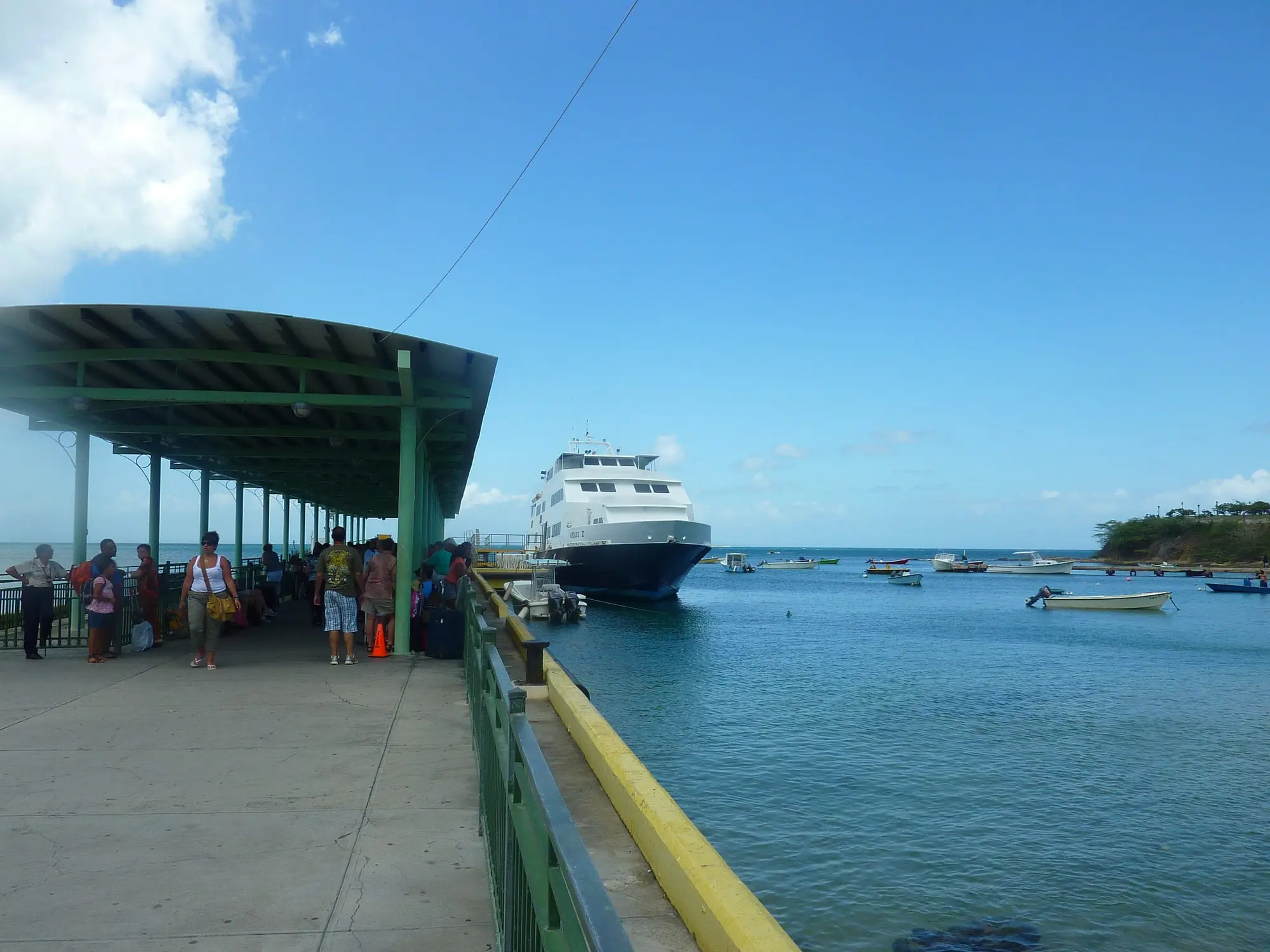

This is the single thing that decides whether a trip to Vieques or Culebra works, and it is the thing the internet is least able to tell you straight.
Search the crossing time and you will be told 30, 45, 50 and 60 minutes — by the operator, by an AI summary, and by three separate guides, all on the first page of results.
What actually holds
| Fact | What holds |
|---|---|
| Where it leaves from | Ceiba, on the east coast at the old Roosevelt Roads base |
| Not | Fajardo. The terminal moved in 2018 and a lot of advice still says Fajardo |
| Crossing to Vieques | About an hour, per the operator. Faster on the fast vessel |
| Crossing to Culebra | Longer — roughly an hour and a half, sometimes quoted at 45 minutes on the fast boat |
| Between the islands | No ferry you can book. Vieques to Culebra means going back through Ceiba |
| Fare to Vieques | $2.00 one way, adult 13–59. $1.00 for ages 4–12 and 60–74 |
| Fare to Culebra | $2.25 one way, adult 13–59, plus a $2 fee for non-residents. $1.00 for ages 4–12 and 60–74 |
| Non-resident fares | Unchanged until 31 December 2026. The rise due in May was postponed — see below |
| Free fares | Babies, and 75 and over — counter only, not sold online. The operator’s rates table counts babies as 0–3, its FAQ as 0–2: how old is a baby |
| Arrive | One hour before departure |
| Boarding closes | Ten minutes before departure, and it is enforced |
| Refunds | None. All sales final; at most two transfers, each an hour ahead |
Fares, the refund rule and the boarding cutoff come off Puerto Rico Ferry’s own rates and FAQ pages. Those are the operator’s pages, not a booking link of ours.
Why the times disagree
Not because anyone is lying. Different vessels run the same route. A fast catamaran and a slower boat produce genuinely different crossing times, and a guide written in a year when one was running will say a number that is wrong in a year when the other is.
The useful version is not a number, it is: budget an hour, and do not build a connection on the far side that assumes the fast boat. Every sailing to both islands and back is on the Ceiba ferry schedule.
The group that tells you what the timetable will not
There is a Facebook group called Vieques Culebra Ferry Watch, where people post what the ticket window is actually saying that day.
That is worth sitting with. A community forms around a timetable only when the timetable cannot be trusted — and the posts are exactly what you would expect: someone reporting the 7 p.m. does not exist and the next boat is at 10.
If you are traveling on a tight day, it is a more current source than any published schedule, including this page. We would check it the morning of.
Booking, and what “sold out” actually means
Book through Puerto Rico Ferry, the operator, or through the City Experiences app. You can also buy at the terminal counter, which takes cash, debit and credit.
Here is the part almost nothing else explains. The operator says two things that sound contradictory and are not:
- “Advance purchase of tickets is not necessary.”
- “Advance sales are limited.”
Both are true, because only a limited block of tickets is released online ahead of a sailing for non-residents. The rest is held back and released at the ticket window on the day of departure. So an empty booking page is not a full boat — it is an exhausted online allocation. Residents get priority boarding either way, along with pregnant women, passengers 60 and over, people with disabilities, and veterans.
What that means in practice: book online if there is inventory, because it is the calm version. If there is none, going to the terminal early is a real option rather than a wasted drive. Either way arrive an hour ahead — and if you are buying at the counter for the very next sailing rather than a future one, you have to be there at least fifteen minutes before it leaves.
Two more things the counter will tell you and the internet will not: there is a limit of five tickets per transaction, and on the island routes each carry-on item needs its own ticket, added during the purchase.
Those fares change on 31 December, not before. The operator announced a non-resident fare structure for 5 May 2026, and on 4 May ATI postponed it to 31 December 2026 while it amends Regulation 9682. As filed, a non-resident adult would then pay $11.25 plus a $2 conservation fee on each crossing, to either island, and $3 for a suitcase beyond the free carry-on. The operator’s banner still says 5 May; its rates table, which is what you pay, still says $2.00 and $2.25. The figures and the budget either side of the change are on what the ferry costs.
At $2.00 one way to Vieques and $2.25 to Culebra, it is far and away the cheapest way to cross.
You cannot take a rental car on it. Puerto Rico Ferry requires a driver’s license and a matching vehicle registration to buy a vehicle ticket, and states plainly that “you may not purchase a vehicle ticket for a rental car.” Its rates page says vehicles may only be brought onboard if they are owned by a resident of Vieques or Culebra. Leave the car on the mainland and rent on the island — book that ahead, because both islands run out on holiday weekends. Christmas to Three Kings is the longest run of them, and the boats fill with islanders going home. Holy Week, 21 to 28 March in 2027, is the other big one.
One more term worth knowing before you book: all ticket sales are final and no refunds are allowed. An unused ticket can be transferred to another departure up to twice, at least an hour before it sails.
The alternative, if you have no car
Day trips sold out of San Juan and Fajardo bundle the ground leg, the crossing and a tour into a single booking. They cost many times the ferry’s round-trip fare, and for someone with no car and no appetite for the drive that can still be the right trade.
One of them is listed at the end of this page. For Culebra, East Island Excursions’ catamaran sails from Puerto del Rey marina in Fajardo, and its listing offers transport from San Juan at an extra charge, so it skips this ferry altogether, and the hunt for its limited online seats with it. It is a beach day, not a snorkel trip. The captain chooses the beach that morning, and in a rough sea it can reroute to Vieques or to a cay off Fajardo, so Culebra itself is not a promise, let alone Flamenco. The Culebra day trip sets it against the same day on the ferry.
For Vieques, the packaged days from San Juan cross on this ferry too; I Ventures, for one, runs its day on it. Residents still board first, and the whole day hangs on the last boat off the island at night; Mosquito Bay from San Juan in a day has the sailings it is built around.
The drive itself is about 75 to 90 minutes from San Juan to the Ceiba terminal, longer in San Juan rush hour — not the two hours it is often quoted at, which is worth knowing before you pay to avoid it. On the pre-dawn sailings the drive is the problem rather than the cost, and where to stay before the Ceiba ferry has the beds closest to the terminal.
Or skip the drive and the boat. Cape Air flies from SJU itself, 25 minutes to Vieques and 20 to Culebra, at many times the ferry fare; flights from San Juan to Vieques and Culebra sets it against Vieques Air Link and its 25-pound baggage limit.
If you are already staying on Vieques or Culebra, those day trips are the wrong purchase, and our tours page says why. The bio bay from the island costs a fraction of the packaged day, and where to stay on Vieques and Culebra names the beds on both islands.
The mistake that costs the most
Assuming the ferry is a detail. Between the limited online allocation, the residents-first boarding, the hour-early arrival and the ten-minute cutoff, this is the least flexible part of the whole trip — and it sits at both ends of it.
Book the ferry first. Build the rest of the trip around what you got.


