
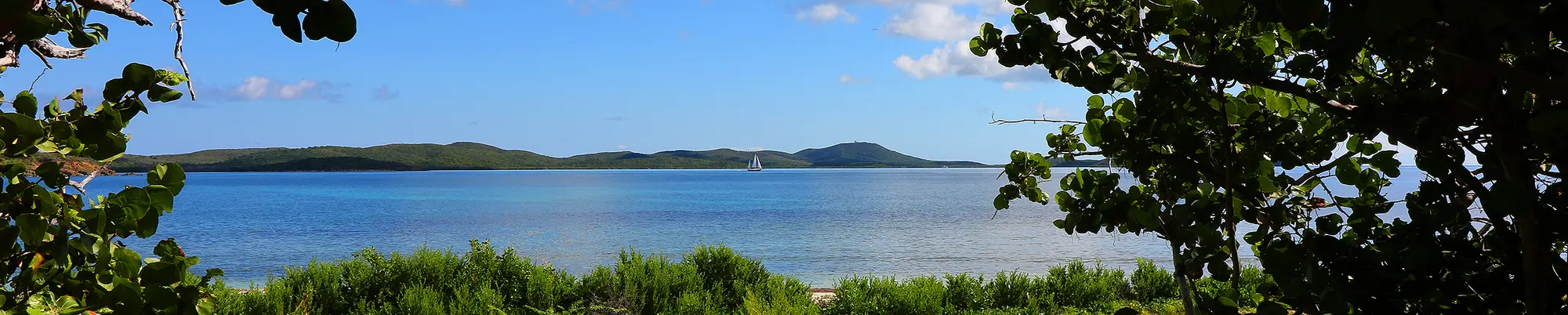
La Chiva is the beach Puerto Rico’s tourism board ranks first on Vieques, and the one the agency that manages the land does not mention anywhere in its visitor information. Both of those things are true, and the second one is worth understanding before you go.
What is actually there
“Often ranked as one of the best beaches in the Caribbean, you can expect diamond-dust sand and an ever-changing palette of blue water at La Chiva, AKA Blue Beach. Also located inside the wildlife refuge… The beach has restrooms as well as a few gazebos on-site. While visitors can enjoy the beach, hikers are not allowed to venture into closed portions of the reserve.”
On the snorkeling, which is the reason most people pick this over Caracas:
“La Chiva’s crystal-clear waters are perfect for snorkeling. There are some rocky areas for the more experienced snorkelers, and shallow ends if you just want to float under the sun. The water… is very clear, and you can see the grass beds scattered across the floor.”
The practical shape of the place is a long shore road with numbered pull-offs, so “the beach is busy” and “your stretch of it is busy” are different questions, and the answer to the second is usually no.
Not on the refuge’s own trail list
The Fish and Wildlife Service lists no trail to La Chiva and does not mention it in its visitor information. Its Visit Us page names trails reaching Playuela, Cerro Playuela, Corcho, Caracas via Tapon, and Puerto Ferro. Its activities page names none of them. The beach the island’s tourism body ranks first does not appear in either.
It is not that the agency has never heard of it — the photograph at the top of this page is the refuge’s own, from its media library, captioned La Chiva Beach. It simply is not in the material a visitor would actually read when planning.
That absence is not a scandal. It is a symptom: this refuge’s public documentation is old. Its only map of which areas are open is dated 22 April 2008, its visitor brochure 17 August 2008, and its conservation plan 1 August 2007 — for an active unexploded-ordnance clean-up whose boundaries have moved since. We go into that on what is actually open in the refuge.
The practical upshot for you: on the day, the signs and gates are the rule.
Free, year round, with rules
“The Vieques NWR can be visited on both the western and eastern sides of Vieques, and is open to the public year-round. Entrance fees are not required.”
The prohibitions that bite on a beach day are no off-road driving, no drones, no open fires or camping, and no removing plants or animals. Snorkeling, SCUBA, kayaking and fishing are explicitly allowed at refuge beaches outside the restricted areas.
If you are shooting for anything commercial — and that includes sponsored content — the refuge requires a Special Use Permit from the Refuge Manager for commercial filming or photography. The office number is 787-851-7258.
Before you go
- Getting in. Enter at the refuge’s main eastern gate off PR-997 at km 3.2 and drive east, further in than Caracas. The beach is a line of numbered pull-offs along the shore rather than one lot; park at any that is empty.
- Hours. The refuge sets no published gate hours. Culebra’s sister refuge publishes “every day of the week from 6:00 AM to 6:00 PM (GMT-4)”; on Vieques, go in daylight and read the gate.
- The vehicle. A jeep or another high-clearance rental. It is what the island’s rental fleets are built around, and the refuge roads are rough.
Verdict
This is the Vieques beach that looks like the photographs, and the snorkeling is genuinely the best on the island. Bring everything, park at whichever pull-off looks empty, and stay off the closed ground.
For the rest of the island’s snorkeling, and Culebra’s, the spots and the trips are sorted by where they leave from.
If you have small children or want to be through the gate in ten minutes, Caracas is the better call — same restrooms, gentler water, much shorter drive.
